Teaching Music with Others in Mind: Centering Connection from the Start
One summer, I found myself wearing a red, white, and blue uniform and playing saxophone at Walt Disney World as part of the Disney All-American College Band. We performed six shows a day for hundreds, sometimes thousands, of park guests, and it remains one of the most formative experiences of my life. Our rehearsals demanded musical excellence, but what left the deepest impression wasn’t technical perfection; it was the constant reminder that our purpose was to create an unforgettable experience for our guests. At Disney, customers aren’t called customers, they’re guests. And we weren’t employees, we were cast members. That language mattered. It signaled a powerful shift: the focus wasn’t on us, but on the people we were performing for.
Initially, this mindset felt unusual. I was used to thinking about my sound and my technique. But Disney demanded something different: connection, energy, and responsiveness to the audience. A good show wasn’t just clean, it was alive. We learned to watch the crowd, feel their energy, and respond with smiles, movement, and intention. I began to see performance not as an act of presentation, but as a shared experience.
That summer reshaped my understanding of music-making. It taught me that the real magic of a performance happens not when we execute perfectly, but when we make people feel something.
Introduction
Music is one of the most powerful ways we connect with other people. It speaks where words fail, lifts spirits, mourns loss, and celebrates life. And yet, in much of formal music education, connection is not the starting point; it’s an afterthought. Too often, the focus is on technical proficiency, individual achievement, and perfect performance. But what if we flipped that script? What if we began by asking a simple, human question:
“Who is this for?”
When we teach music with others in mind, our listeners, our peers, our communities, we transform the act of performance from a personal showcase into a shared experience. This article examines how centering others in music teaching and learning promotes empathy, cultivates stronger musicians, and revitalizes the purpose of music education.
A Shift from “Look at Me” to “I Made This for You”
Many students are taught to approach music performance like an audition: eyes on them, judgment in the air, every note measured against perfection. While this may develop discipline, it often sidelines the deeper purpose of music: communicating something meaningful to someone else.
When performance becomes solely about how well I did, it becomes isolating. Students may:
Feel anxious about mistakes.
Struggle to engage emotionally.
See music as a self-centered endeavor rather than a relational one.
But when we shift the frame from “look at me” to “I made this for you,” everything changes. The music becomes a gift. The performance becomes a bridge. And the student becomes not just a performer, but a communicator and giver.
Thinking About Others: Why It Matters
Centering others in the learning and performance process cultivates skills and mindsets that go beyond music. It nurtures qualities we want in every student: empathy, purpose, creativity, and confidence.
1. Empathy and Emotional Intelligence
When students consider how their audience might feel during a piece, they begin to develop empathy. They learn to consider perspectives outside their own. They begin asking:
“Will this sound too harsh?”
“How can I make this moment feel more peaceful?”
“What emotion am I inviting the listener to experience?”
That’s emotional intelligence in action.
2. Purpose-Driven Performance
Performing for others gives music purpose. It’s not just about getting the notes right, it’s about delivering a message. Whether it’s joy, sorrow, power, or peace, students learn to play with intent. This makes their practice more meaningful and their performances more impactful.
3. Stronger Connection and Engagement
Thinking about others builds community. It turns the audience into participants, not bystanders. Students feel more connected to the people they’re performing for, and those people feel more connected to the music.
Practical Ways to Start With the Audience in Mind
So how do we shift toward this mindset in music teaching? It’s not about overhauling everything; it’s about intentionally weaving others into the learning process from the start.
1. Begin with a Question: Who Is This For?
Introduce any new piece, composition project, or performance with this prompt: Who do you imagine will hear this? What do you hope they feel?
Let that shape how students learn, rehearse, and refine the music. This small shift reorients students toward communication and away from self-consciousness.
2. Build Audience Awareness into Rehearsal
Use questions like:
“If someone were hearing this for the first time, what would stand out?”
“What do you want someone in the back row to feel during this crescendo?”
“How can your phrasing help the audience understand the story?”
These prompts help students shape their music around human connection, not just execution.
3. Practice Listening as Much as Playing
Connection isn’t just about sending out a message; it’s also about tuning in. Have students reflect on:
How their peers’ performances made them feel.
How different interpretations affect the same piece.
What elements in music help them feel something when they’re in the audience?
Students become more sensitive performers when they also practice being sensitive listeners.
4. Create Feedback Loops with Real Audiences
Invite people into the process, such as family members, peers, teachers from other disciplines, or even students from younger grades. After performances, ask:
“What did this music make you think or feel?”
“Was there a moment that drew you in?”
“Did anything feel unclear or confusing?”
This feedback doesn’t evaluate perfection; it affirms connection.
5. Encourage Expression and Personal Meaning
Let students adapt, arrange, or interpret music to express something personal for someone else. Let them dedicate a piece to someone, write music as a message, or tell a story through performance.
This helps them realize that music is not just about what’s written on the page; it’s about how they deliver it.
6. Memorize Early and Remove Physical Barriers
For groups like modern bands, choirs, or small ensembles, avoiding music stands altogether can enhance audience connection from the start. Encourage students to begin memorizing parts early in the rehearsal process, not as a test of memory, but as a way to free their eyes, bodies, and attention. Without stands blocking their view, students naturally begin to engage with the audience, move expressively, and perform with greater confidence. Memorization also encourages deeper internalization of the music, which supports more emotive and spontaneous performance. The absence of a stand signals to students: This music lives in you now, share it freely.
A Difference Approach: A Circle, Not a Line
In many traditional music classrooms, the flow of music is linear:
Composer → Teacher → Student → Audience
The student is a conduit, and the audience is a receiver. But this model limits agency and narrows the opportunity for connection.
Instead, imagine a circle:
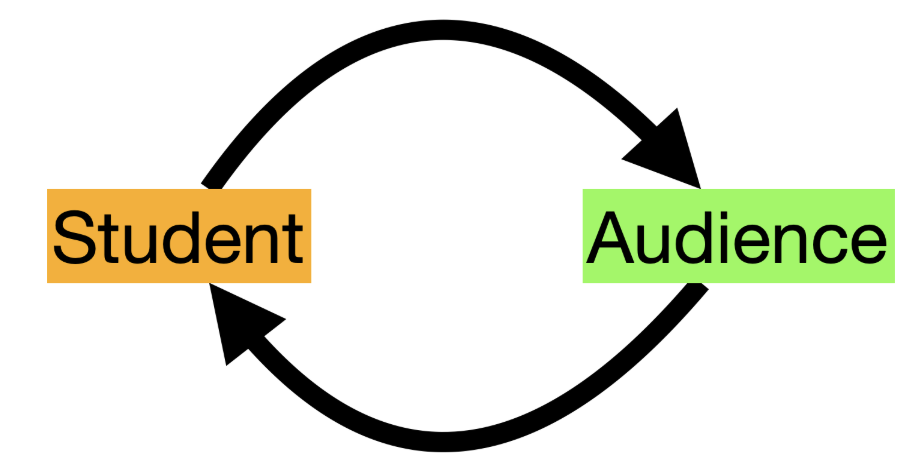
In this model:
Students shape the music with the audience in mind.
Audiences influence how students perform.
Feedback, emotion, and interaction flow in both directions.
This relational model reinforces that performance is a shared experience, not a test.
What This Looks Like Across Music Education Contexts
This audience-centered, empathy-driven model works in more than just solo or recital settings. It applies across genres and learning environments:
In Band and Orchestra
Ask students to describe the feeling they want to create in a specific passage.
Rehearse dynamics and phrasing with emotional cues (“make this sound like a sunrise”).
Perform in settings where students can see and interact with their audience, such as gym concerts, community centers, and school assemblies.
In Choir
Explore the text deeply: What does it mean? Who are we singing to?
Try singing a piece for someone in mind, like a family member, a community, a cause.
Use body language and expression to deepen emotional communication.
In Modern Band and Popular Music
Let students choose songs that matter to them and explore how those songs affect others.
Encourage students to write and perform songs that address real-life issues or convey messages to specific individuals.
Perform in informal venues that allow a closer, more direct connection with listeners.
In General Music or Composition
Frame creative projects as messages or gifts.
Have students create music for specific audiences (a lullaby for a baby sibling, a beat for a friend, a theme for a school event).
Reflect not just on what they made, but who they made it for.
Long-Term Impact: Life Beyond the Classroom
Teaching music with others in mind doesn’t just improve performance; it also enhances the overall experience. It prepares students for life.
It builds empathy. - Students practice imagining how others feel, a foundational skill for being a thoughtful human.
It fosters social connection - Music becomes a way to form bonds, build trust, and express care. It’s no longer just “my” music, it’s “our” experience.
It reduces anxiety and perfectionism - When the goal is to share something rather than prove something, students relax. They learn that even imperfect performances can be deeply meaningful.
It cultivates lifelong music-making - Students who view music as a means of connection are more likely to continue playing, writing, and sharing music outside of school. They’re not just musicians, they’re music-makers.
What Drives the Music? A Tale of Two Performances
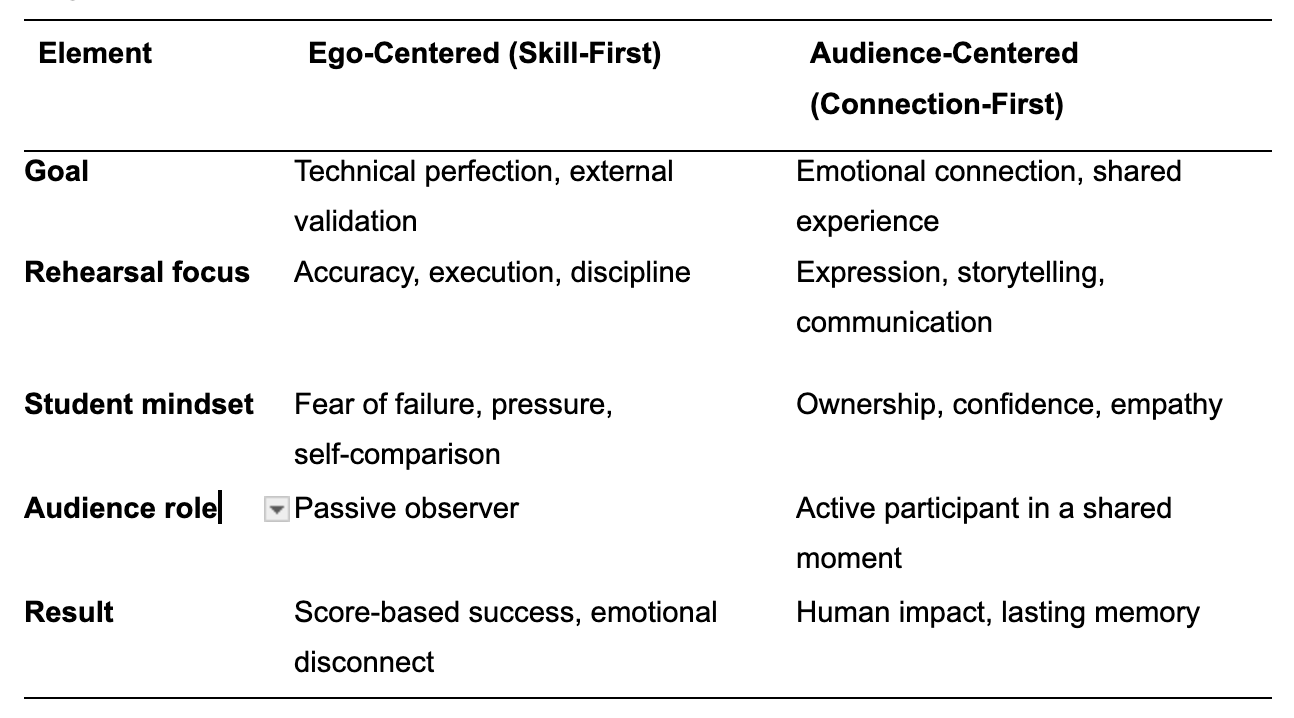
In music education, the mindset students adopt during preparation can significantly influence the outcome of a performance, not only in terms of quality but also in emotional impact and meaning. Consider two contrasting scenarios: one rooted in an ego-centered approach that focuses solely on technical perfection, and the other guided by an audience-centered mindset where connection and communication are the primary goals from the outset. These two paths reveal how different teaching philosophies influence not only how students play, but why they play, and how their performances are received.
Scenario 1: Ego-Centered Performance (Skill-First Mindset)
Setting: A high school wind ensemble is preparing for their state contest.
Preparation:
The conductor selects a technically demanding piece to “showcase” the band’s abilities. Rehearsals focus on precision: correct rhythms, tuning, articulation, and blend. Students receive the message, either explicitly or implicitly,, “We’re striving for a Division I rating.” Mistakes are met with frustration, and students grow anxious about being “the one who messes it up.”
Each section is drilled repeatedly with an emphasis on “getting it right.” There is little discussion of the music’s emotional content or the audience’s experience. The performance is framed as a test of the ensemble’s worth.
Student mindset:
Many students become tense and withdrawn. Some internalize the idea that their self-worth is tied to playing correctly. Others disengage, feeling the process is more about the conductor's reputation than the music itself. There’s minimal collaboration or student agency.
Performance:
On stage, students stare at their music. Eyes rarely lift. They play cautiously, more focused on avoiding mistakes than expressing anything. The audience claps politely but feels no connection to the music. The band earns a “Superior” rating, but the emotional takeaway is muted, even for the students.
Post-performance:
The conversation centers around missed entrances and out-of-tune chords. The performance is deemed a success by the score, but students don’t feel changed by the experience. Several quietly wonder why it mattered at all.
Scenario 2: Audience-Centered Performance (Connection-First Mindset)
Setting: A high school modern band is preparing for a community concert at a local park.
Preparation:
The band director opens the first rehearsal by asking, “What kind of experience do we want to create for the people who will be listening?” Students brainstorm: joy, energy, connection, hope. They choose songs that reflect these goals, including one original composition dedicated to their graduating seniors.
Rehearsals include musical work but also storytelling:
“What do you think people will feel when they hear this verse?”
“Where do we want the audience to lean in and really listen?”
“How can we shape this ending to leave them with goosebumps?”
“What can we do to get the audience engaged in the music?”
Mistakes are addressed, but always in service of better communication. Students experiment with tempo and dynamics to match the mood they want to convey. They rehearse smiling, looking up, and connecting with the crowd, even during instrumental parts.
Student mindset:
Students feel ownership and purpose. Their goal isn’t to be perfect, it’s to move people. They laugh during rehearsals, encourage one another, and reflect on the meaning of their music. Confidence grows because the pressure to impress is replaced by a genuine desire to express oneself.
Performance:
The crowd gathers on blankets and folding chairs. Students introduce each song with short personal reflections. During the performance, they make eye contact, move naturally, and feel connected. There are a few minor mistakes, but they go unnoticed because the energy and emotion are palpable.
Post-performance:
The audience cheers. Several people tell the students how the songs made them feel. One parent tears up during the original composition. Students beam with pride, not because they were flawless, but because they made something that mattered. They ask when they can do it again.
Key Differences at a Glance
Why This Matters Now
In a time when students face social disconnection, mental health challenges, and performance pressure, music education can offer something deeply healing: the chance to feel seen, to connect, and to care about others.
By teaching with others in mind:
We create more inclusive, meaningful performances.
We bring joy back into the learning process.
We remind students, and ourselves, why music matters.
As music educators, we’re not just teaching notes and rhythms. We’re helping students learn how to care.
Conclusion
I was recently in Memphis, Tennessee, eating at a restaurant on Beale Street when I noticed a quote from one of the waitresses printed on the wall: “Take care of the customer. If you don’t, someone else will.” It struck me how deeply that idea applies to music education. What if every music lesson began not with, “What are you supposed to play?” but with, “Who are you playing this for?” That one question shifts everything. It invites students into a larger story, one where music becomes a language of empathy, a bridge between people, and a gift to be shared. It moves us beyond isolated achievement toward meaningful connection. Because when we teach music with others in mind, we’re not just shaping better musicians, we’re shaping a more compassionate world.
