
What If Adaptive Music Were Not an Adaptation?
What I Saw at River Hills
When our faculty punk-metal band, Corn Riot, played at River Hills School, I saw something that affected me deeply. Some of the students were dancing. Others were rocking, swaying, vocalizing, or simply allowing the sound to move through their bodies. Their responses did not all look the same, but they were unmistakably connected to the music.
These children were having a real musical experience. They were not sitting quietly and waiting for someone to tell them how to respond. They were not demonstrating that they could reproduce a rhythm, follow notation, or perform a predetermined part. They were experiencing the music and responding to it in ways that were immediate, physical, personal, and joyful.
At first, I thought I was simply witnessing children enjoying a rock band. But the experience stayed with me. I began to wonder whether I was seeing something more important.
These students were responding to music in ways that children in many other schools rarely do. In most school music settings, students are taught to contain their responses. They learn to sit still, remain quiet, watch the conductor, and wait for the proper time to make sound. Even during listening activities, “good listening” is often demonstrated through silence and physical control. Moving spontaneously, vocalizing, or reacting visibly may be interpreted as distraction, disruption, or a failure to follow directions.
The students at River Hills had not failed to participate appropriately. They may have been showing us how narrow our definition of appropriate musical participation has become.
Adapting Students Into an Existing Model
Music educators have done important work to make music classrooms more accessible to children with disabilities. Teachers have adapted instruments, simplified musical parts, rearranged classroom environments, created visual supports, used assistive technology, and modified instruction. All of these practices can remove barriers and create meaningful opportunities for students.
But much of what we call adaptive music education still begins with an existing image of what music class is supposed to look like. We begin with band, choir, orchestra, or general music and then ask how a child with a disability can participate in that structure. We adapt the instrument so the student can play it. We simplify the notation so the student can read it. We alter the environment so the student can remain in it. We modify the instruction so the student can complete the same basic activity as everyone else.
The adaptations may be thoughtful, creative, and valuable. Yet the underlying goal often remains unchanged: help the child participate in something that already exists.
This approach begins with the traditional music classroom and works backward toward the child. What if we reversed the process? What if we began with the child’s existing ways of experiencing, expressing, and connecting through music? What might we design if the traditional music class were not our starting point?
That question does not require us to abandon instrument playing, singing, or performance. It asks us to stop assuming that these are the only destinations toward which meaningful music education should move.
Modern Band Offers a Useful Comparison
Modern band helped me understand that music education does not have to resemble a traditional band in order to be legitimate, rigorous, and meaningful. A modern band may include guitars, keyboards, drum sets, singers, rappers, producers, and digital musicians. Students may learn by listening, watching, imitating, experimenting, or working with peers. They may choose their own songs, rearrange the music, create original material, or change roles from one rehearsal to the next. The teacher may spend less time conducting and more time facilitating decisions, solving problems, and helping students develop their ideas.
Modern band does not look like concert band with different instruments. It is built upon different musical practices, different relationships, and often a different understanding of participation. We did not simply adapt a trumpet part for a guitar and call it modern band. We reconsidered what students might do, how they might learn, what music might belong in school, and what role the teacher might play.
Yet modern band is still music education. It can involve listening, creating, responding, performing, collaborating, problem-solving, and developing musicianship. Its value does not depend upon how closely it resembles the traditional ensemble.
That same imaginative freedom could transform music education for children with disabilities.
Instead of asking how to adapt children into traditional music classes, we could design entirely new kinds of musical environments around the ways children already engage with sound. These classes might look very different from band, choir, orchestra, or even conventional general music. That difference would not make them lesser forms of music education. It might allow us to recognize forms of musical participation that our existing structures have overlooked.
Participation Is Bigger Than Performance
One of the strongest assumptions in music education is that meaningful participation eventually leads to performance. Listening, movement, exploration, and response are often treated as steps toward the real goal: playing or singing something correctly.cBut the children at River Hills were already participating. Their dancing was not preparation for music-making. It was music-making. Their movements, vocalizations, gestures, expressions, and changes in attention were part of their relationship with the music.
A student does not need to reproduce a melody to experience anticipation. A child does not need to hold an instrument in the conventional way to make a musical choice. A student does not need to sing an assigned part to communicate through sound. Musical participation can include moving, selecting, initiating, responding, exploring, directing, arranging, listening, feeling vibration, operating technology, controlling lights, or affecting what other musicians do next.
A child might select which song the group hears. Another might trigger one sound at an important moment. A student might use movement to communicate changes in tempo or intensity. A child might choose between sounds, instruments, colors, or musical environments. One student might enjoy being surrounded by sound, while another might prefer to participate from a quieter space. Some children may want to repeat the same musical experience many times. Others may constantly seek new sounds. These are not consolation prizes for students who cannot participate in “real” music. They are real forms of musical agency.
The question should not be whether every child can approximate the participation we had already planned. The question should be whether every child can find a meaningful way to affect, experience, and belong within the musical environment.
Designing From the Child Outward
A reimagined music class would begin with observation rather than instruction.
What draws this child toward music?
What sounds do they seek?
What sounds do they avoid?
How do they express preference?
How do they show anticipation?
What movements emerge when music begins?
What causes them to initiate, repeat, pause, or connect with another person?
What conditions help them feel safe enough to explore?
The teacher would use these observations to design musical possibilities. The goal would not be to correct the child’s natural response to make it look more like conventional music-making. The goal would be to recognize that response and help the child expand it.
If a student rocks to a steady pulse, the teacher might mirror the movement, let it influence the tempo, or invite other musicians to respond. If a child reaches toward a speaker when the bass enters, the class might explore vibration through drums, resonant surfaces, or a subwoofer. If a student vocalizes during musical pauses, the musicians might begin to leave space for those sounds and treat them as part of the piece. If a child repeatedly activates one sound, the teacher might help the group build music around it rather than immediately moving the student toward a more complex task.
This requires a different kind of teaching. The teacher is not simply delivering a lesson and measuring how closely each student follows it. The teacher is noticing, interpreting, offering possibilities, and responding. The curriculum develops through interactions among the child, the teacher, the environment, and the music.
That does not mean the class has no structure. In fact, thoughtful structure may be essential. Students may need predictable routines, clear transitions, limited choices, repeated experiences, visual cues, sensory supports, or consistent musical signals. But structure should make participation possible. It should not be assumed that all participation must look the same.
A Classroom With Many Musical Roles
This kind of music class could include instruments, but instruments would be only one way into the experience. The room might also include microphones, switches, looping devices, projected images, lights, resonant objects, movement spaces, tactile materials, and technologies that allow students to control sound in different ways.
A musical experience might begin with a live groove played by teachers, peers, or guest musicians. Students could enter the music through whatever role is meaningful to them. One child might play a drum. Another might move. Someone might control when the lights change. Another student might choose the next section of the music. A child might sing, vocalize, or activate a recorded sound. Someone else might sit close to the musicians and listen. Another might leave and return.
The experience would not depend upon everyone doing the same thing at the same time. It would depend upon creating a shared musical world with multiple ways to enter it.
Over time, the teacher could invite students into new forms of participation. Movement might lead to controlling tempo. A preference for two songs might lead to creating a playlist. Repeated vocalizations might become material for a loop. Interest in light might develop into controlling a visual sequence that shapes the performance. Playing one sound might grow into deciding when the whole group should stop or start.
Growth would still matter, but growth would not be defined by movement toward a single traditional form of musicianship. It would mean expanding each child’s ability to choose, communicate, contribute, express, interact, and shape musical experiences.
Rethinking What Counts as Learning
If we redesign the class, we must also redesign assessment. Traditional assessment might ask whether a student maintained a steady beat, sang the correct pitches, read a symbol, played a pattern, or followed the teacher’s directions. Those skills may remain appropriate for some students and some experiences, but they cannot be the only evidence that musical learning has occurred.
We might instead look for evidence that a student recognized what was about to happen, communicated a musical preference, initiated an action, made a choice, responded to another person, explored a new sound, repeated something intentionally, changed an action based on what they heard, or discovered a role they wanted to continue.
We could ask whether the student’s range of possible participation expanded. Did the child find a new way to enter the music? Did they begin to recognize that their action affected the group? Did they communicate something through sound or movement? Did they develop a stronger connection with another person? Did they experience enough safety and belonging to take a musical risk?
These forms of learning may be difficult to reduce to a standardized sequence of skills. They require close observation and careful interpretation. But they may reveal much more about a child’s musical life than whether the child reproduced a predetermined rhythm.
My four elements of meaningful music-making offer one possible foundation: contribution, personal expression, belonging, and enjoyment and engagement. Did the student have a way to contribute? Could the student express something of themselves? Did the student experience membership in a shared musical community? Was the experience compelling enough for the student to want to remain, return, or participate again?
Those questions could guide curriculum, instruction, and assessment without requiring every child to arrive at the same musical outcome.
What If the Children Are Showing Us the Way?
It would be easy to describe the students at River Hills as children who need a specially adapted version of music education. But I now wonder whether they were showing me something that all of music education needs to recover. Music moves human beings before it becomes a school subject. We dance, sway, sing, shout, repeat, remember, and connect. We use music to regulate our bodies, communicate identity, build relationships, and experience joy. None of this depends upon reading notation, sitting correctly, or preparing a concert.
Schools often take this expansive human experience and narrow it into a limited set of acceptable behaviors. We decide what music students will make, how they will make it, when they may respond, and what their bodies should do while the music is happening. Then we encounter children whose musical responses do not fit those expectations and assume that the children need to be adapted.
Perhaps the model needs to be adapted.
What I saw at River Hills was not an incomplete version of a traditional music class. It was a glimpse of another possibility. The children were not waiting for us to teach them how to become musical. They were already living inside the music. They were responding with their bodies, emotions, attention, and relationships.
The challenge is not merely to help children with disabilities gain access to the kinds of music education we have always offered. The larger challenge is to imagine forms of music education spacious enough to recognize how these children are already musical. Modern band taught us that music education can look entirely different from band and still be extraordinary music education. Children with disabilities may be inviting us to make an even more significant leap. We can continue adjusting instruments, modifying lessons, and adapting environments, but we can also create something new.
We can design music classes in which movement is music-making, listening is participation, preference is decision-making, response is communication, and joy is evidence that something meaningful is happening.
The children at River Hills did not need Corn Riot to turn the music into a lesson. We played, and they found their own ways into it.
Perhaps our task is to build music education from there.
Designing Meaningful Music Participation Worksheet
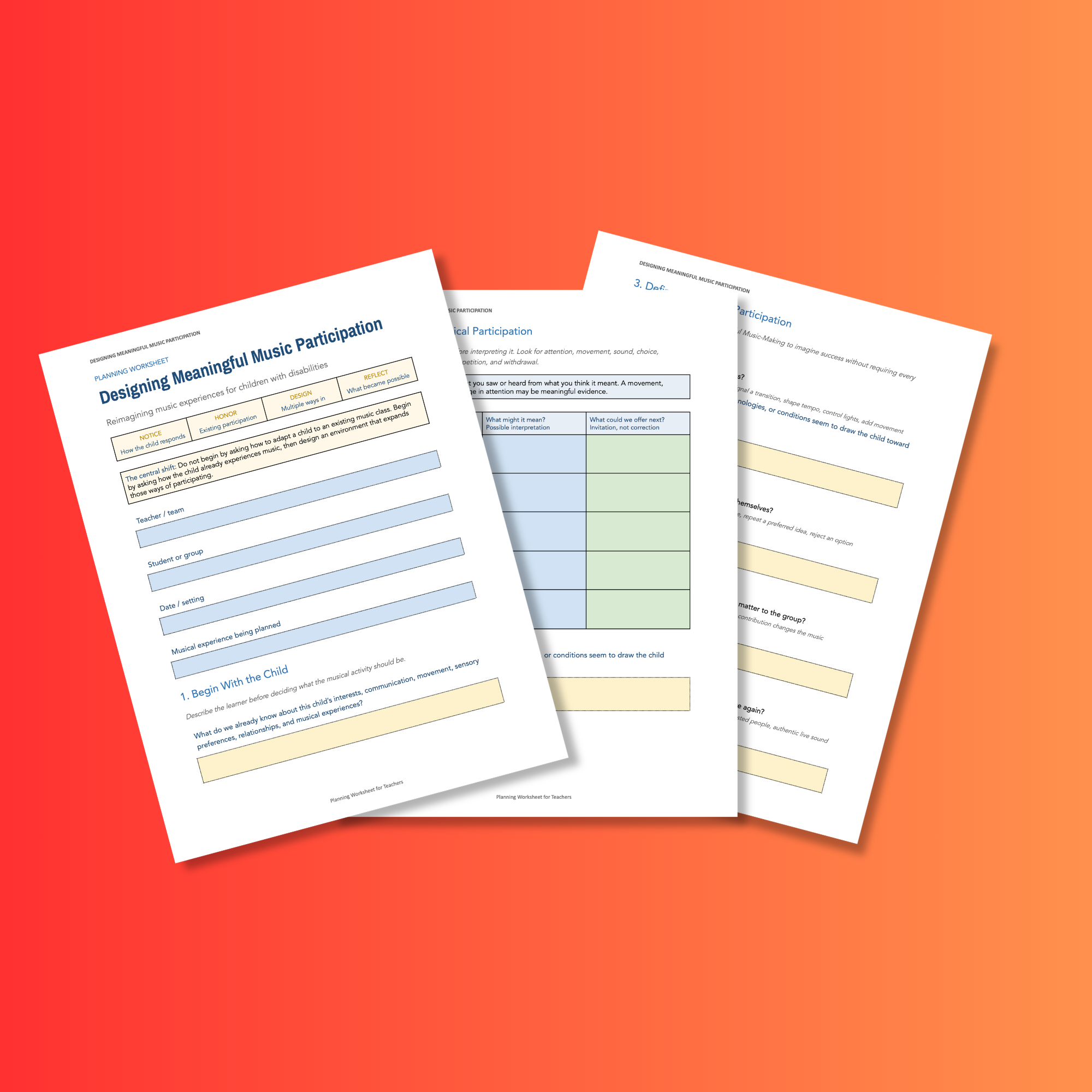
Designing Meaningful Music Participation
Use this planning worksheet to design music experiences that build on how children already move, respond, choose, communicate, and connect through music. Rather than adapting students into a traditional music class, the worksheet helps teachers expand musical roles, remove barriers, plan multiple ways to participate, and reflect on what becomes possible.
