
The Sharing Phase: Designing for Contribution
Designing Musical Growth – Essay 4
In the first essay of this series, I asked a question that has stayed with me for a long time.
What kind of musician are we trying to develop?
Over the next two essays, I suggested that students grow through three interconnected modes of musical growth.
In the Technical phase, students learn to produce music.
In the Embodiment phase, they learn to participate in music through their bodies.
But there is one final question.
Who is this music for?
I have come to believe that this question changes everything.
When Music Changes Direction
One of the patterns I've noticed throughout my teaching is that students' attention gradually expands. In the Technical phase, their attention is directed inward. They are thinking about notes, rhythms, fingerings, breathing, and all of the countless decisions required to produce music. As they become technically fluent, they begin to enter the Embodiment phase. Their attention expands beyond simply producing sound. They begin participating physically in the music. They move with it. They breathe with it. They begin developing a relationship with it.
Eventually, however, something changes again. Their attention leaves themselves altogether. They begin thinking about other people.
Their fellow musicians.
Their audience.
Their community.
The music is no longer simply something they know. It becomes something they can give.
To me, that shift represents one of the highest goals of music education.
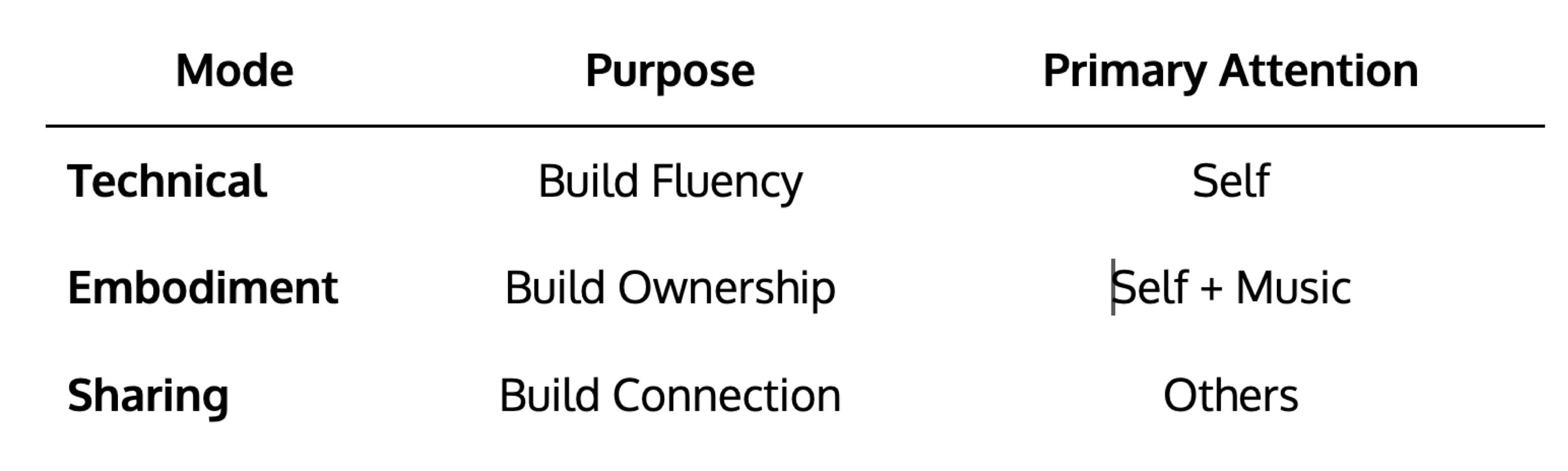
Modes of Musicianship Development
To me, that shift represents one of the highest goals of music education.
Music Becomes an Act of Generosity
One of the biggest changes in my own teaching has been realizing that performances are not demonstrations of learning. They are opportunities for generosity. When students first learn a piece, they naturally ask,"Can I play this?" Later they begin asking, "How should this feel?" Eventually, I hope they begin asking something different.
"What can we give?"
That question changes the purpose of performance. Music becomes something we offer rather than something we demonstrate. Audiences certainly appreciate technical excellence. But I don't think they attend concerts hoping to watch students successfully complete difficult musical tasks. They come hoping to feel something.
To laugh.
To remember.
To celebrate.
To grieve.
To be inspired.
To experience joy alongside another human being.
When students understand that, they stop performing at an audience. They begin performing for an audience. That is a profound difference.
Designing for Contribution
If contribution is the purpose of the Sharing phase, then we must intentionally design for it. It doesn't happen automatically simply because students know the notes or have begun embodying the music. Just as technical fluency and embodiment require intentional design, so does sharing. That begins with the questions we ask. Instead of asking only, "Was that accurate?" we might ask, "How do you want the audience to feel during this piece?" Instead of saying, "Play louder here," we might ask, "What are you trying to communicate?"
Before performances, I sometimes encourage students to imagine a single person sitting in the audience. Perhaps it's a child attending their first concert. Perhaps it's a grandparent. Perhaps it's someone who's had a difficult week. Then I ask,
"What do you hope they take home with them?"
Suddenly, dynamics become more than volume. Phrasing becomes more than shaping notes. Music becomes communication.
Rehearsing for the Audience
If performances are about contribution, then rehearsals should occasionally reflect that purpose. Students shouldn't spend every rehearsal thinking only about notes, rhythms, and the conductor. They also need opportunities to think about the people they will eventually serve through their music.
At the end of a run-through, I'll often have the band stand and acknowledge the audience, even though there isn't one there. Students turn toward the empty seats. They offer a slight smile, a nod, or wave to an imaginary parent or sibling. It only takes a few seconds, but it reminds them that they aren't rehearsing just to play the music correctly. They're rehearsing to share it with real people.
There are many ways teachers can reinforce this mindset. Students might perform for another class, record themselves and ask, "Would I feel connected if I were listening?" or introduce a piece by explaining why they chose it or what they hope the audience experiences. None of these activities replace technical rehearsal. They build upon it, reminding students that music is ultimately about relationships with other people.
What Sharing Looks Like
I've seen this transformation happen countless times.
At the Colorado Masonic Band Camp, the final parade is completely different from the first rehearsal. During those early rehearsals, students are focused on marching, counting, and playing the correct notes. By the end of the week, something has changed. They're waving to children along the parade route, making eye contact with spectators, and smiling. They're genuinely excited about getting the crowd "pumped up." Their attention has shifted from simply playing the music correctly to creating an enjoyable experience for the people around them.
I see a similar transformation at Amp Camp at the University of Northern Iowa. At the end of the concert, students often toss guitar picks or drumsticks into the audience. We have a simple motto at Amp Camp: “When the audience gives you applause, you need to give something back.” It's a small gesture, but it reflects something much bigger. The performance is no longer simply a demonstration of what they've learned. It has become a celebration shared with the community.
Those moments remind me that audiences aren't passive observers. They're participants in the musical experience. When students shift their attention toward the people in front of them, the performance changes. Music stops being something they demonstrate and becomes something they genuinely offer.
Assessment Changes Again
If contribution is the purpose of this phase, then our assessment changes once again. We're no longer asking only, Can students produce the music? We're no longer asking only, Are they participating physically in the music? Instead, we begin asking different kinds of questions.
Did they communicate something meaningful?
Did they connect with the audience?
Did they invite people into the musical experience?
Did the audience feel welcomed?
Did students seem aware that someone beyond themselves was listening?
Those questions are certainly more difficult to answer than whether students played the correct notes or rhythms. They require observation, reflection, and sometimes even conversations with performers and audience members. Yet I believe they are much closer to the reasons most people make music in the first place. After all, music has never been only about producing beautiful sounds. It has always been about using those sounds to connect with other human beings.
Music Is Something We Do Together
In his influential book Musicking, musicologist Christopher Small (1998) argued that music is fundamentally something people do, not simply something they create or consume. He used the term musicking to describe the many ways people participate in musical events. Not only by performing, but also by listening, rehearsing, dancing, organizing, and gathering together. In Small's view, the meaning of music is found not only in the sounds themselves but also in the relationships created through the musical experience.
I believe the Sharing phase extends that idea into music education. Our goal is not simply to prepare students to perform concerts. It is to prepare them to use music to contribute to the lives of others. A concert performance is one opportunity to do that, but it is far from the only one.
Sometimes that contribution happens on a concert stage. Sometimes it happens around a campfire, in a church, at a hospital bedside, or in a garage band rehearsal. Sometimes it happens when a parent sings a child to sleep or when friends gather around a piano after a holiday meal. Music enters people's lives in countless ways, and I hope our students leave our classrooms believing they have something meaningful to offer in all of those places…not just on a stage.
Performance is one way music enters the world.
Contribution is the larger purpose.
Looking Back
When I began this series, I asked a simple question:
What kind of musician are we trying to develop?
Today, I think my answer is different from what it would have been a few years ago. I still want students to become technically fluent. I still want them to participate fully in music. But ultimately, I want them to become people who use music to enrich the lives of others.
Perhaps that's why this framework matters so much to me. Technical fluency makes participation possible. Participation makes contribution possible. And contribution is where music becomes deeply meaningful. Not only for the performer but also for the people whose lives are touched by it.
Every time I say goodbye to my son, I tell him the same thing:
"Make a difference in someone's life."
The longer I teach, the more I wonder if that's what music education has been trying to teach me all along. Not simply how to make music, but how to use music to make a difference in someone else's life.
Perhaps the highest purpose of music education isn't helping students become better musicians. Perhaps it's helping them become people who know how to use music to make a difference in someone else's life.
If our students leave our classrooms technically fluent, physically engaged, and eager to use music to enrich the lives of others, then perhaps we've accomplished something far greater than preparing a successful performance. Perhaps we've helped prepare a meaningful life.
Reference
Small, C. (1998). Musicking: The Meanings of Performing and Listening. Wesleyan University Press.
