
What Kind of Musician Are We Trying to Develop?
Designing Musical Growth – Essay 1
A Question That Changed My Thinking
Every time I say goodbye to my son, I tell him the same thing…
"Make a difference in someone's life."
It's become a simple ritual between us. Then, after my cancer diagnosis, I realized something. I needed to ask myself the same question.
Have I made a difference?
I've devoted my career, really, much of my life, to music education. When you're suddenly reminded that life is finite, you begin asking different questions. I wasn't wondering whether I had rehearsed enough concerts or taught enough scales. I found myself wondering something much deeper.
Has my life's work actually made a difference in people's lives?
As I reflected on that question, I realized I wasn't really asking whether I had been successful. I was asking whether I had been meaningful. That question has stayed with me. Eventually, it led to another question that I believe sits at the heart of music education.
What kind of musician are we trying to develop?
It's a remarkably simple question, yet I'm not sure we ask it often enough. Instead, we spend much of our time asking other questions. What repertoire should we perform? How difficult should the music be? How do we improve tone, intonation, rhythm, balance, and technique? Those are all worthwhile questions. But they assume we've already answered the larger one.
What is the purpose of all of this?
Two Camps, One Pattern
Over the years, I've noticed something that I couldn't quite explain. For more than twenty years, I've taught at the Colorado Masonic Band Camp, a concert and marching band experience. Every summer, I watch the same transformation.
On the first day, students are almost statues. Their eyes rarely leave the page. Their attention is consumed by notes, rhythms, fingerings, counting, breathing, and avoiding mistakes. They are exactly where we would expect students to be when learning unfamiliar music. By the end of the week, something remarkable has changed.
They're moving with the music.
They're smiling.
They're making eye contact with one another.
During the parade they're waving to spectators and high-fiving children along the street.
During the concert they aren't simply performing the music anymore. They're sharing it.
For years, I assumed this happened simply because students became more confident. Then I started noticing the exact same pattern somewhere completely different. At Amp Camp, students spend the week in modern bands writing songs, arranging music, improvising, and learning popular music. On the first day, they're learning chords, grooves, equipment, and basic technical skills. By the middle of the week, they're making musical decisions together. They're shaping the music. They're beginning to own it.
By the final concert, they're celebrating with the audience. They invite people into the experience. They throw guitar picks and drumsticks into the crowd. The performance feels less like a recital and more like a celebration.
Different setting.
Different repertoire.
Different instruments.
The same transformation.
After watching students in these two very different settings over many years, I began to realize that I wasn't really watching students learn music…
I was watching them develop a relationship with music.
Three Modes of Musical Growth
That realization has changed the way I think about music education. I no longer think students simply move from "not knowing" to "knowing." Instead, I believe they move through three interconnected modes of musical growth.
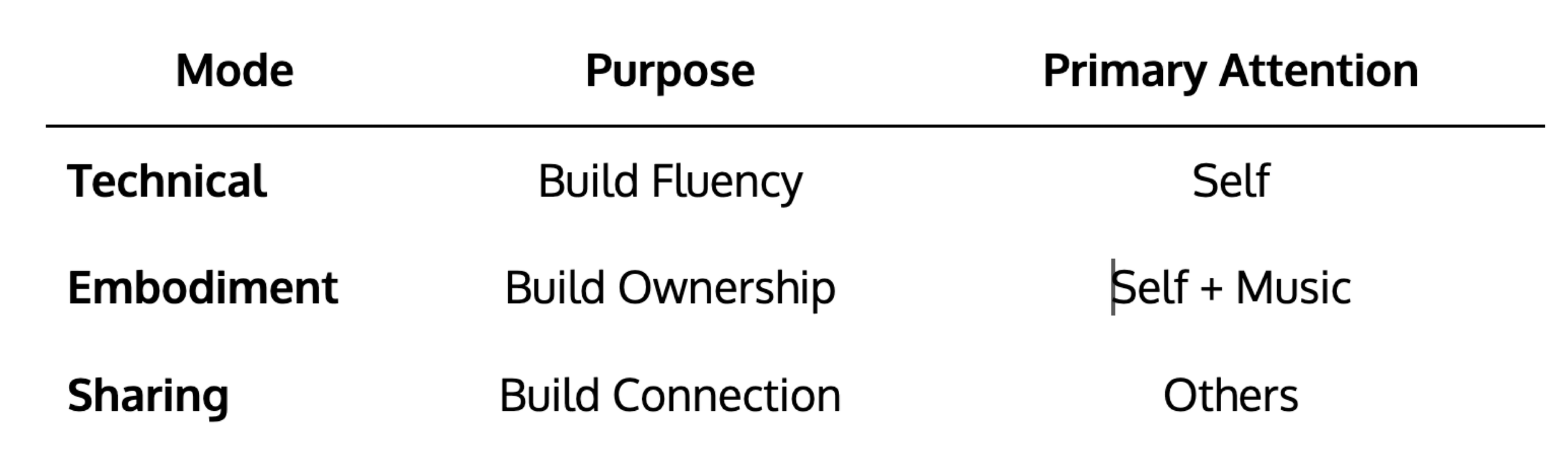
Three Modes of Musical Growth
Notice that as students grow, their attention expands. These are not rigid stages that students complete one after another. Students move back and forth between them throughout the learning process. A difficult passage may require returning to technical work before moving once again toward embodiment and sharing. The point isn't to leave one mode behind forever. The point is to recognize that each mode serves a different purpose and asks something different of both students and teachers.
In the Technical mode, students build fluency. Their attention is directed inward as they learn notes, rhythms, fingerings, coordination, and the countless technical skills required to make music with confidence. Technical fluency is essential, but I've come to believe it is the beginning of the journey rather than its destination.
As technical demands become more automatic, students begin to enter Embodiment. Their attention expands beyond simply executing the music. They begin to experience it, make it their own, and develop a personal relationship with what they're playing. The music starts to belong to them.
Finally comes Sharing. Here, students' attention shifts toward other people. Music is no longer simply something to perform accurately or even something personally meaningful. It becomes something to offer. Students begin asking not only "Can I play this?" but also "What can I give?"
Over time, I've come to believe that meaningful music education isn't simply about helping students become technically proficient musicians. It's about helping them grow through all three of these modes. In the essays that follow, I'll explore each one in greater depth and share practical ways teachers can intentionally design experiences that support students along this journey.
Redefining Success
Many of us were trained to define musical success primarily through technical achievement. Did students play the correct notes? Were they together? Was the intonation accurate?
Those questions still matter. Technical fluency is essential. But I've come to believe it isn't the destination. Technical fluency creates the possibility for ownership. Ownership creates the possibility for sharing. And when students genuinely share music with others, something beautiful happens.
Music becomes an act of generosity.
This way of thinking has changed nearly every decision I make as a teacher. It changes how I choose repertoire because I no longer ask only, Can my students perform this? I also ask, Will they eventually stop thinking about this music and start living inside it?
It changes how I plan rehearsals.
It changes how I think about assessment.
It changes what I consider a successful performance.
Perhaps that's what audiences remember most. They certainly appreciate technical excellence. But what stays with them is often something deeper. They remember how the performance made them feel. They remember the joy on students' faces. They remember feeling connected to the performers. They remember that something meaningful was offered rather than simply demonstrated.
Looking Ahead
Over the next three essays, I'll explore each of these modes in greater depth:
The Technical Phase: Designing for Fluency
The Embodiment Phase: Designing for Ownership
The Sharing Phase: Designing for Connection
My hope isn't to replace the excellent work music teachers already do. It's simply to offer another way of thinking about how students grow, not just as musicians, but as people. Because I keep coming back to two questions.
What kind of musician are we trying to develop?
And perhaps even more importantly,
What kind of person are we helping them become?
The longer I teach, the less I believe my legacy will be measured by how many technically proficient musicians I helped create. I hope it will be measured by how many people learned to use music to make a difference in someone else's life. Because perhaps that is the kind of musician we're really trying to develop.
And perhaps, through music, the kind of person we're hoping they become.
